
The corporate travel industry has spent the last three years watching AI move from curiosity to infrastructure. Travel managers are using it to research suppliers. Category analysts are using it to benchmark programs. And increasingly, procurement decisions are being shaped before a single RFP is issued, by what AI systems know about your company and what they choose to surface.
A recent Phocuswright study found that 56 percent of U.S. travelers are already using AI for travel-related research, with generative AI functioning as the primary discovery entry point. Industry data shows AI search queries grew 527 percent year-over-year between early 2024 and early 2025. AI-driven web traffic now converts at 4.4 times the rate of traditional organic traffic.
For corporate travel suppliers, including TMCs, airlines, hotel groups, and OBTs, the implication is direct: if your brand is not accurately and consistently represented in structured, verifiable data, you are invisible to the AI systems your prospects are using to build shortlists.
The question is no longer whether AI influences supplier decisions. The question is whether your organization controls how it is represented when those decisions happen.
This is not about SEO in the traditional sense. It is about something more fundamental: the quality, structure, and accessibility of your underlying data. At Gazzebo, we built the platform to address exactly this problem, before the AI visibility conversation became mainstream.

Corporate travel procurement has always had a discovery problem. Buyers rely on relationships, word-of-mouth, and incomplete RFP distribution lists to find suppliers. Suppliers rely on account teams and marketing budgets to get in front of buyers. Neither approach scales. Neither approach produces reliable outcomes.
The arrival of AI has not solved this problem. It has amplified it. AI systems generate answers from structured, authoritative, and consistently formatted data. They favor verified sources over self-reported claims. They weight recency, accuracy, and trustworthiness. Suppliers with fragmented or outdated data do not just rank lower. They disappear.
The industry has historically accepted this as a cost of doing business. Gazzebo was built on the premise that it does not have to be.

Phocuswright research presented at the Travel Marketing AI Summit described the challenge directly: brands need "first-party gold mine data" that makes them unreplaceable to large language models. One executive noted that travel companies should want their data feeds, whether through API or MCP connection, to reach buyers directly rather than forcing buyers to search for them.
That is the core proposition of Gazzebo. We give suppliers the infrastructure to make their data accessible, structured, and AI-ready, so that the moment a buyer asks an AI system which TMC serves APAC with strong sustainability programs, the answer includes the right companies with verified, current information.

Gazzebo is a structured procurement marketplace purpose-built for corporate travel. The platform connects buyers with verified suppliers through standardized RFx workflows, AI-powered matching, and 200-plus standardized data points per supplier profile. It is free for buyers. Suppliers subscribe based on visibility, engagement, and capability access.
AI visibility is not a feature we added. It is embedded in the architecture of how profiles are built, maintained, and surfaced.

Every supplier on Gazzebo completes a structured profiler covering more than 200 standardized data fields across eleven sections: general information, service model, technology stack, coverage, traveler support, NDC capability, sustainability, culture and inclusion, information security, program services, and invoicing. Each section is designed to capture the information buyers actually need to make sourcing decisions, and the information AI systems need to accurately represent a supplier.
The profiler is not a directory listing. It is a structured data asset. When a buyer or an AI agent queries Gazzebo for TMCs serving a particular market, the results are generated from verified, normalized data, not from scraped websites or static marketing copy.

The AI Facts Manager is the optimization layer within the supplier journey on Gazzebo. It sits at the Optimize stage of the supplier workflow, between completing the profiler and entering discovery by buyers.
The tool helps suppliers identify where their profile data is incomplete, outdated, or inconsistently formatted, and provides guidance on strengthening those areas. The goal is not to game AI systems. It is to ensure that the data Gazzebo holds on a supplier is accurate, complete, and current enough to be trustworthy. Verified data is what AI systems surface. Incomplete or stale data is what they skip.
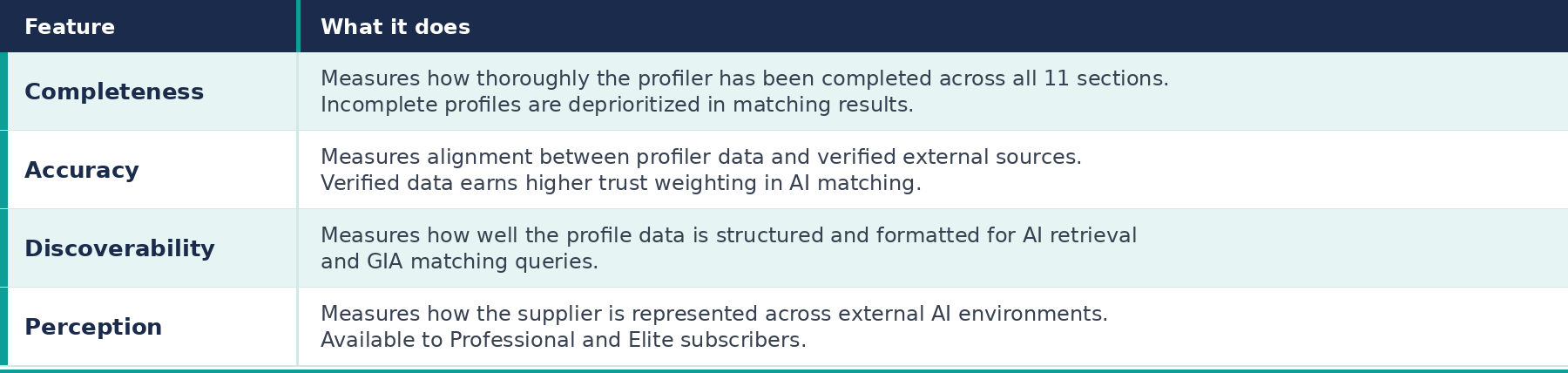
Gazzebo tracks AI readiness across four dimensions for supplier profiles: Completeness, measuring how thoroughly the profiler has been filled out; Accuracy, measuring alignment between profiler data and external verifiable sources; Discoverability, measuring how optimally the data is structured for AI retrieval; and Perception, measuring how the supplier is represented in external AI environments. Higher-tier subscription plans unlock the full dashboard, deeper scoring, and competitive monitoring across each dimension.

Live Insights is a real-time intelligence feed built into every supplier profile. It uses the Perplexity API to surface current news, LinkedIn activity, and financial signals related to a supplier, combined with Claude AI sentiment analysis to generate a structured summary of what is being said about that company externally.
The feed updates every 24 hours and is accessible both to the supplier themselves and to buyers reviewing that profile. For suppliers, it creates accountability: the platform reflects your external reputation, not just your self-reported data. For buyers, it provides a risk and context layer that was previously unavailable in any structured form.
Live Insights is one of several features that distinguishes a Gazzebo profile from a static company listing. The profile is a living data asset, not a brochure.

GIA, the Gazzebo Intelligence Assistant, is the AI backbone of the platform. It operates across the full sourcing workflow and serves both buyers and suppliers, though its role is different for each.
For Buyers
GIA enables natural language search across the entire supplier database. A buyer can ask: Which TMCs operate in Latin America with NDC capability and a sustainability program? GIA applies more than 50 matching factors to surface relevant results from verified profiler data. It handles follow-up comparisons, generates side-by-side capability analyses, and provides proactive guidance based on where a buyer is in their sourcing workflow.
GIA also alerts buyers when profiler data for a supplier they are evaluating is more than six months old, providing a freshness score and prompting them to weigh data recency in their evaluation. This is a small but meaningful signal in a procurement context: stale data carries risk.
The result is a sourcing experience that is dramatically faster and more informed than the traditional RFP distribution model. Buyers surface the right suppliers before issuing a single document. GIA does not replace the procurement process. It compresses the discovery and evaluation stages that have historically consumed the most time.
For Suppliers
GIA recognizes supplier users and adapts accordingly. When a supplier logs into Gazzebo, GIA offers profile optimization guidance, explains what buyers in the current market are filtering for, surfaces relevant RFx opportunities, and provides context on buyer behavior and market signals. It functions as an intelligent account assistant without requiring a dedicated account manager on the supplier side.
Suppliers at the Professional tier and above can also query GIA to understand how their profile compares to competitors across specific dimensions, where they rank in AI matching for common buyer queries, and what specific data improvements would meaningfully improve their discoverability.
GIA is not a chatbot layered on top of a directory. It is a context-aware procurement assistant built on verified structured data with 50-plus matching factors applied at query time.

One of the more significant shifts underway in AI-driven procurement is the emergence of Model Context Protocol, or MCP, as the standard for connecting AI agents to external data sources. MCP allows AI systems, whether an enterprise procurement agent, a custom GPT, or a platform like Gazzebo, to directly query structured data sources rather than relying on web search or scraped content.
Gazzebo is in the process of implementing MCP across the platform. The goal is to make supplier profiles, coverage data, capabilities, and fact-verified information queryable by any MCP-compliant AI system. This includes external enterprise procurement tools, custom AI deployments at large buyer organizations, and AI agents embedded in travel management workflows.

The practical implication for suppliers: a complete, accurate Gazzebo profile becomes discoverable not just within the Gazzebo platform, but across any AI system that queries Gazzebo's data layer via MCP. Verified, structured supplier data becomes the connective tissue between supplier visibility and AI-powered procurement decisions.
The PhocusWire reporting captured this clearly. One executive at the Travel Marketing AI Summit described the ideal future state as an AI agent that can pull verified hotel or supplier data directly, without requiring the buyer to navigate to a separate platform. That architecture requires trusted, structured data sources with clean API or MCP interfaces. Gazzebo is building that infrastructure for corporate travel.

AI visibility is not just a marketing question. It directly affects sourcing outcomes for both buyers and suppliers.

The most important shift in corporate travel procurement is that shortlists are increasingly being formed before a formal RFP process begins. A travel manager researching TMC options for an upcoming renewal uses AI tools to surface candidates. The suppliers that appear in that early research phase have a meaningful head start. Those that do not appear often never receive the RFP at all.
A well-maintained Gazzebo profile, with complete profiler data, current Live Insights, and active engagement with the AI Facts Manager, is a supplier's best instrument for ensuring they are present in that early research phase. It is also the most cost-effective one. The platform is free to join at the Basic tier, with no requirement for account management overhead or marketing spend to maintain a verified presence.

The persistent challenge in corporate travel procurement has been data quality. Buyers have historically evaluated suppliers from a combination of self-reported information, account manager presentations, and industry reputation. None of these sources is independently verified. All of them introduce bias.
Gazzebo replaces that process with structured evaluation against standardized data points. Every supplier profile contains the same fields, organized the same way, with data freshness tracked and surfaced to buyers. GIA's comparative analysis applies consistent logic across all suppliers. Buyers make decisions from a level playing field for the first time.
The combination of Live Insights, profiler freshness scoring, and AI-powered matching gives buyers a more complete picture of each supplier than a traditional RFP process typically produces, in less time, and with less manual coordination.

Perhaps the most important function Gazzebo serves is structural. Corporate travel procurement has lacked a neutral, structured layer between buyers and suppliers since the industry's origination. Relationships filled that gap for decades. Consolidation eroded many of those relationships. AI is now filling it in a new way, but AI without verified data produces unreliable results.
Gazzebo provides the verified data layer that makes AI-assisted procurement trustworthy. Buyers can rely on the information they receive. Suppliers control their own representation. AI systems have a structured, authoritative source to draw from.

If you are a supplier in corporate travel and you have not yet built a verified presence on a structured procurement platform, the window for being early is still open. The AI systems that buyers are using to shape their sourcing decisions are learning from the data that exists today. What is structured, verified, and current gets surfaced. What is not, does not.
If you are a buyer, the structured sourcing infrastructure that makes AI-assisted procurement reliable is available now. You do not need to wait for the market to mature. The data layer is live, the matching is operational, and the transparency gap that has characterized this category for two decades can be addressed starting from your next sourcing cycle.

Explore the platform at gazzebo.ai. The demo requires no login.